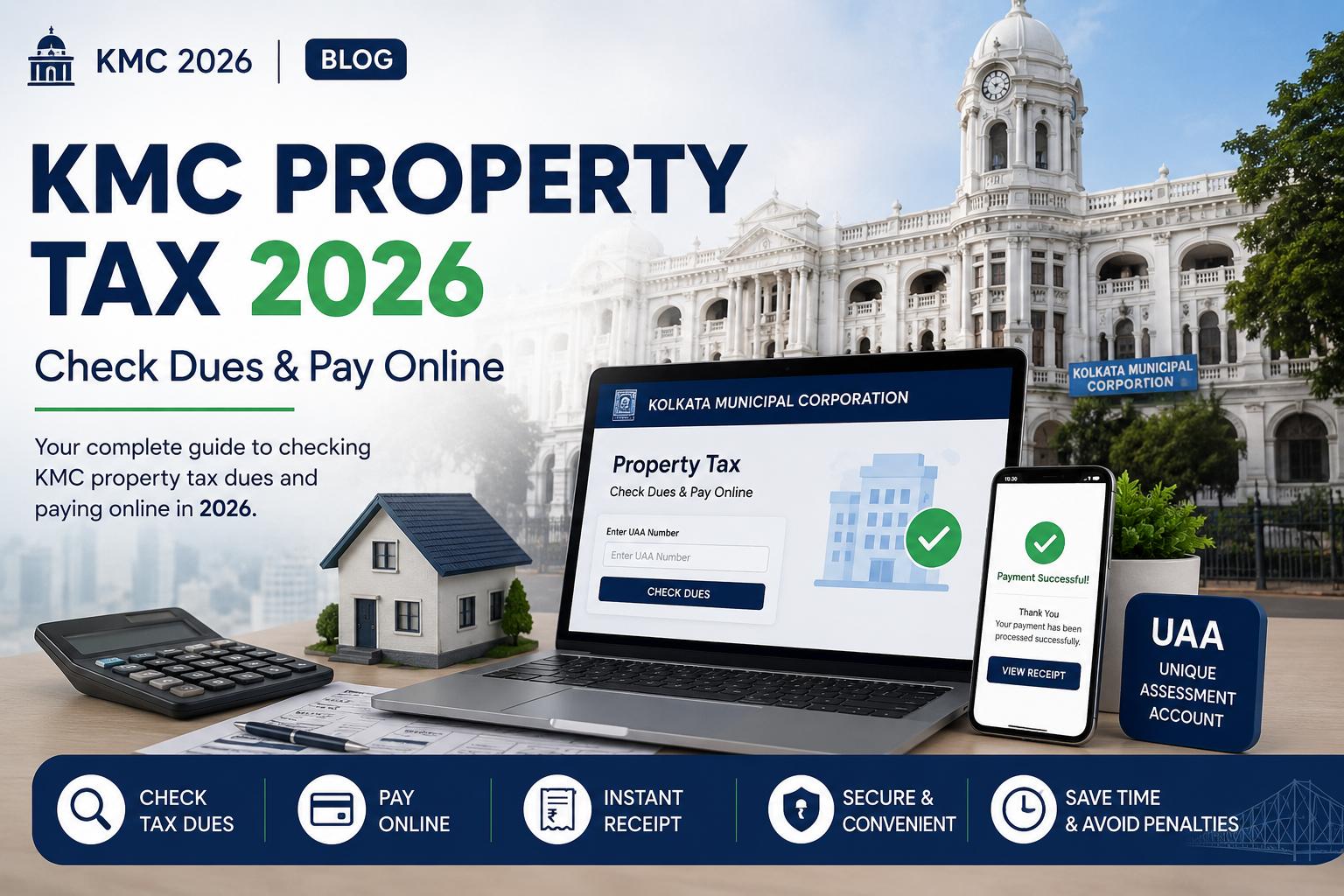
Every year, roughly six lakh property owners in Kolkata get a demand bill from the Kolkata Municipal Corporation. Most pay it without reading it. A smaller number don’t pay it at all — and then discover, sometimes a decade later, that they cannot sell their flat, cannot mutate it into their name, and cannot get a home loan sanctioned against it, because a Nil Dues Certificate is impossible to obtain.
Property tax in Kolkata is not a large number. For most residential flats it lands somewhere between ₹8,000 and ₹60,000 a year. But it is a number that quietly controls whether your property paperwork is clean, and clean paperwork is what a buyer’s lawyer looks for first.
This guide covers three things: how to check what you owe, how to pay it, and how the Unit Area Assessment system actually calculates the figure — including one multiplier that catches almost every buyer of a large flat by surprise.
One warning before we start. A large number of property websites state that the KMC tax rate is “0.5% to 3% of annual value.” That is wrong — it is a figure copied from other cities and repeated. Kolkata’s statutory band under UAA is 6% to 20%, and most ordinary residential properties sit at the top of that band. We’ll show the real arithmetic below.
First: Are You Even Under KMC?
This is the single most common mistake, and it wastes an enormous amount of people’s time.
The Kolkata Municipal Corporation covers 144 wards — broadly, the city proper. It does not cover several of the areas where most new residential supply is actually being built. If your flat is in one of these, KMC’s portal will never show your assessee number, because you don’t have one.
| Where your property is | Who collects your property tax | Where to pay |
|---|---|---|
| Ballygunge, Alipore, New Alipore, Tollygunge, Kasba, Behala, EM Bypass (city side), Jadavpur, Garia, North Kolkata | Kolkata Municipal Corporation (KMC) | kmcgov.in |
| New Town (Action Areas I, II, III) | New Town Kolkata Development Authority (NKDA) | nkdamar.org |
| Salt Lake, Rajarhat–Gopalpur, Baguiati, Kestopur | Bidhannagar Municipal Corporation (BMC) | bmcwbgov.in |
| Sodepur, Madhyamgram, Barasat, Rajpur–Sonarpur | Respective municipality | Municipality office / e-District |
| Outer Rajarhat, Joka fringe, Amtala, parts of Bhangar | Gram Panchayat | Panchayat office |
NKDA residents were, until recently, redirected to the state’s e-District portal, which was built for all urban local bodies and did not align well with NKDA’s own municipal services framework — producing server outages and technical glitches. NKDA has since moved property tax payment onto its own website. Bidhannagar Municipal Corporation, which governs Salt Lake and Rajarhat–Gopalpur, has separately been introducing the Bharat Bill Payment System.
The rest of this guide is about KMC specifically. If you’re under NKDA or BMC, the calculation logic differs — Bidhannagar’s Rajarhat–Gopalpur wards, for instance, use an entirely different formula based on building area multiplied by a weightage and a common factor of 0.2.
Step 1: Find Your Assessee Number
Everything on the KMC system runs on the Assessee Number. It is not your flat number, not your ward number, and not anything printed on your Deed of Conveyance. It is a KMC-generated identifier tied to the premises.
Three places to find it:
- Any past KMC tax receipt or demand bill. It’s printed at the top. Easiest route if you have one.
- The KMC portal. Go to kmcgov.in and use Assessee Information Search. You’ll need your ward number, street name and premises number. The system returns the assessee number and the linked property details.
- Your borough office. If the premises was recently mutated or the building is new, the online record may lag. The Assessment–Collection department at your borough office can look it up from the premises address.
If you have just bought a flat: the assessee number will usually still be in the seller’s name, or in the developer’s name for the whole building, until mutation is completed. That is normal. Get the number from the seller’s last receipt.
Step 2: Check What You Actually Owe
Do this before you pay anything, and definitely before you buy anything.
On kmcgov.in, under Online Services → Assessment Collection, you’ll find:
- Check Payment Status — enter the assessee number to see the current position and transaction history
- All Bill — shows every outstanding demand against the property, quarter by quarter
- Reprint E-Receipt — retrieves past receipts by assessee number and date range
The “All Bill” view is the one that matters. It shows arrears, not just the current quarter. A property that looks clean on the last receipt can still carry six years of unpaid bills from before the last owner started paying.
For buyers: ask the seller for a current printout of All Bill, not an old paid challan. A seller who happily gives you a two-year-old receipt but won’t pull a live dues screen is telling you something. Outstanding tax blocks mutation, and mutation blocks your ability to resell — a problem we’ve written about in detail in our guide on what actually happens when you try to sell a 15-year-old Kolkata flat.
Step 3: Pay Online
The process is straightforward once you have the assessee number.
- Go to kmcgov.in
- From Quick Links on the right of the homepage, click Make Online Payment
- Select Property Tax
- Choose All Bill to see everything outstanding, or the specific PD bill you want to clear
- Enter your assessee number, registered mobile number and email
- Click Search to view dues
- Select the bill and proceed
- Pay by UPI, net banking, debit card or credit card
- Download the e-receipt immediately
That last step matters more than it sounds. The e-receipt is a legally valid document accepted for mutation, registration and loan files. Download it, rename it with the year, and keep it in the same folder as your deed. You will be asked for the last three years of receipts the day you decide to sell.
Offline alternative: KMC Assessment–Collection counters at borough offices, designated bank branches, and e-Kolkata Citizen Service Centres. Always collect a stamped receipt.
Step 4: Understand Unit Area Assessment (The Part Nobody Explains)
Kolkata switched to Unit Area Assessment in April 2017, replacing the old Annual Rateable Value system where an inspector decided your valuation and you argued about it afterwards. UAA is formula-driven, which means you can calculate your own tax and check whether KMC has assessed you correctly.
The building blocks
KMC’s 141 wards are divided into conceptual valuation blocks, each categorised into one of seven categories — A through G, with A the highest and G the lowest. There are 293 such blocks in total. Each category carries a Base Unit Area Value (BUAV) — a notional annual value per square foot.
| Block category | BUAV per sq ft |
|---|---|
| A | ₹74 |
| B | ₹56 |
| C | ₹42 |
| D | ₹32 |
| E | ₹24 |
| F | ₹18 |
| G | ₹13 |
Block G covers slum areas across Kolkata to reduce the burden on economically weaker sections, and Block E covers Refugee Rehabilitation colonies and areas under government EWS schemes.
Because two flats in the same block can be wildly different, KMC then applies Multiplicative Factors — six of them.
Location (road width in front of the premises)
| Road width | MF |
|---|---|
| Up to 2.5 m | 0.6 |
| 2.5 m to 3.5 m | 0.8 |
| 3.5 m to 12 m | 1.0 |
| Over 12 m | 1.2 |
Age of building
| Age | MF |
|---|---|
| Up to 20 years | 1.0 |
| 20 to 50 years | 0.9 |
| Over 50 years | 0.8 |
Occupancy
| Status | MF |
|---|---|
| Owner-occupied or family occupation | 1.0 |
| Tenanted under 20 years, residential | 1.5 |
| Tenanted under 20 years, non-residential | 4.0 |
| Tenanted 20–50 years, not protected under WB premises rules | 1.2 |
| Tenanted 20–50 years, protected | 1.0 |
| Tenanted over 50 years | 1.0 |
| Garage / paid parking space | 4.0 |
Usage
Residential 1.0 · shops and restaurants 2.0 · schools, hospitals, sub-3-star hotels 3.0 · offices and banks 5.0 · malls and multiplexes 6.0 · hoardings and towers 7.0 · vacant land over 5 katha 8.0.
Structure
| Type | MF |
|---|---|
| Pucca | 1.0 |
| Semi-pucca | 0.6 |
| Kutcha | 0.5 |
| Common area | 0.5 |
| Covered/open parking, garage | 0.8 |
| Residential building on plot over 10 katha | 1.5 |
| Special projects, or apartments with covered space over 2,000 sq ft | 1.5 |
The formula
Annual Value = Covered Area × BUAV × Location MF × Usage MF × Age MF × Structure MF × Occupancy MF
Annual Tax = Annual Value × Rate of Tax
The statutory band for the rate of tax under UAA runs from 6% to 20%, and it does not depend on the annual valuation of the property the way the old system did. Developed bustee properties are fixed at 8%. In KMC’s own published worked examples, an ordinary multi-storeyed residential property is computed at 20% of annual value, with a further 0.5% Howrah Bridge Tax applied in the notified wards, giving 20.5% in total; a slum property at the 8% rate with an annual value of ₹940 works out to about ₹78 a year.
Two more mechanics worth knowing:
- Tax capping. Where the nature and character of the property has not changed, your tax cannot rise or fall by more than 20% from the previously assessed figure in the transition to UAA. This protects owners of old North Kolkata properties from sudden spikes.
- The 2025 enhancement. From 1 April 2025, KMC implemented a five-yearly 10% property tax increase across all properties, as mandated by the state government. The hike is interim, and further changes may follow once the new assessment list is finalised.
The 2,000 Square Foot Trap
Look again at the structure table. An apartment with covered space over 2,000 sq ft carries a structure MF of 1.5.
That is not a 50% jump in the base value. It is a 50% jump in the entire annual value, and therefore in the tax. And it kicks in at a hard threshold.
Two flats in the same Category B block, both on a 12m-plus road, both five years old, both owner-occupied, both pucca:
Flat A — 1,900 sq ft covered space
1,900 × ₹56 × 1.2 × 1.0 × 1.0 × 1.0 × 1.0 = ₹1,27,680 annual value
Tax at 20% = ₹25,536 per year
Flat B — 2,200 sq ft covered space
2,200 × ₹56 × 1.2 × 1.0 × 1.5 × 1.0 = ₹2,21,760 annual value
Tax at 20% = ₹44,352 per year
Flat B is 15.8% larger. It pays 74% more tax. Forever.
Add the 10% enhancement from April 2025 and Flat B is at roughly ₹48,800 a year against Flat A’s ₹28,100 — a gap of ₹20,700 annually, or over ₹2 lakh across a decade of ownership.
This matters at the ₹2–5 crore end of the Kolkata market, where 2,000 sq ft is exactly the size band buyers hover around. If you are choosing between a 1,950 sq ft unit and a 2,150 sq ft unit in the same tower, the tax difference is a real and permanent part of your cost of ownership — and no developer’s cost sheet will mention it. It is the same category of omission we mapped out in our breakdown of the hidden costs of buying a flat in Kolkata, and it’s worth running through our Total Cost Calculator before you commit to a unit size.
Note that “covered space” for a flat is not the same as the super built-up figure on the brochure, and it is not the carpet area either. It includes your exclusive covered area plus a proportionate share of the building’s common area, with common area carried at a structure MF of 0.5. If you are unclear on the distinction between these three measurements, our guide on carpet area vs built-up vs super built-up works through it properly — or use the Carpet vs Super Built-Up tool for a quick conversion.
A Second Worked Example: A Rented Flat
Same logic, different lever. A 1,200 sq ft flat in a Category D block, ten years old, on a 6m road, pucca construction.
Owner-occupied
1,200 × ₹32 × 1.0 × 1.0 × 1.0 × 1.0 × 1.0 = ₹38,400 AV
Tax at 20% = ₹7,680 per year
Let out on a standard residential tenancy — occupancy MF becomes 1.5
1,200 × ₹32 × 1.0 × 1.0 × 1.0 × 1.0 × 1.5 = ₹57,600 AV
Tax at 20% = ₹11,520 per year
An extra ₹3,840 a year the moment a tenant moves in. If you are calculating rental yield on a Kolkata investment property, this belongs in the model — as does the buy-versus-rent maths, which our Rent vs Buy Calculator handles. Most yield calculations you’ll see online quietly omit the occupancy loading altogether.
Rebates, Concessions and Due Dates
KMC bills quarterly through Periodic Demand (PD) bills, presented roughly in April, July, November and February.
Rebates available:
- 5% of the quarterly tax if you pay within the rebate deadline for that quarter
- An additional 5% if you pay all four quarters together within the first quarter’s rebate window
- 1% extra for paying online, capped at ₹200 per payment
Paying the full year upfront in April is therefore worth roughly 10–11% off. On a ₹45,000 annual bill that is close to ₹5,000 — a better risk-free return than most places you could park the money for a year.
Concessions:
- Senior citizens aged 60 and above get a 10% exemption on annual property tax. The age threshold was lowered from 65, bringing a much larger group into eligibility. It is not automatic — you must apply with proof of age at your borough office.
- Waterbody preservation. Owners maintaining ponds or tanks on their premises may receive relief depending on the extent and quality of preservation.
- Construction delay relief. The window to commence construction after a sanctioned building plan has been extended from 2 years to 5 years.
- Properties with an annual valuation below ₹300 are exempt. Slum properties with an annual value of ₹500 or less also fall outside the net.
If You Have Arrears: The Graded Waiver Scheme
This is the section to read carefully if you have inherited a property, or bought one where the previous owner had stopped paying.
Unpaid KMC tax accrues both interest and a one-time penalty that can run up to 15% of the outstanding amount. Over a decade, the penalty and interest can exceed the principal.
KMC ran a flat waiver scheme for years — 50% off interest and 99% off penalty on one-time payment, regardless of how long the dues had been outstanding. This drew complaints from taxpayers who felt long-term defaulters were being rewarded on the same terms as recent ones. From 1 August 2024, KMC replaced it with a graded structure:
| Length of default | Waiver on penalty | Waiver on interest |
|---|---|---|
| Under 2 years | 99% | 50% |
| 2 to 5 years | 75% | 45% |
| 5 to 10 years | 50% | 40% |
| Over 10 years | 25% | 35% |
You still pay the principal in full. What gets reduced is the penalty and interest layered on top.
Two practical points. First, the relief shrinks the longer you wait, so there is no strategic value in delaying further. Second, these schemes are time-bound and revised periodically — check the live notification on kmcgov.in or at your borough office before assuming the table above is still current, and get your final payable figure calculated at the Assessment–Collection counter with your assessee number in hand.
What continued default actually costs you: beyond the money, KMC can refuse mutation, block transfer and registration, initiate recovery proceedings, and in extreme cases attach and auction the property. In practice, the mutation refusal is what stops people — you cannot sell what you cannot mutate.
Why This Matters at the Point of Sale
If you are buying a resale flat in Kolkata, treat KMC tax as a due-diligence item, not an afterthought. It sits alongside stamp duty and registration charges as one of the statutory costs that determine whether a transaction closes cleanly.
Ask the seller for:
- A current “All Bill” printout from the KMC portal, dated within the last week
- Tax receipts for the last three financial years
- A Nil Dues Certificate from the Assessment–Collection department
The Nil Dues Certificate is the document that confirms nothing is pending against the assessee number. Mutation and registration will not progress without it, and it is typically valid for one year from issue. If the seller resists producing one, assume there are arrears and price accordingly — or walk.
If you are buying a new flat from a developer: your unit will not have its own assessee number until the building is assessed post-completion. Until then the whole premises is assessed as one holding, usually in the developer’s or landowner’s name, and the developer pays. Your individual assessment gets created after you complete mutation in your own name. Budget for the first bill to arrive some months after possession, and check with the developer whether any tax for the pre-handover period is being passed on to buyers — some cost sheets include it, some don’t. This is one of the differences worth weighing in our guide on new launch vs ready-to-move.
Frequently Asked Questions
Is the KMC property tax rate really 0.5% to 3%?
No. That figure circulates widely online and is incorrect for Kolkata. The UAA statutory band is 6% to 20% of annual value, applied as a flat rate that does not vary with the size of the valuation. Ordinary residential properties are computed at 20% in KMC’s own published examples, plus 0.5% Howrah Bridge Tax in notified wards.
Where can I calculate my own tax?
KMC publishes a property tax calculator on kmcgov.in under Assessment Collection. Run your own numbers using the tables above first, then check them against the calculator. If the two diverge significantly, your recorded covered area or multiplicative factors may be wrong — which is worth raising, because the error compounds every year.
Can I pay someone else’s property tax?
Yes. The portal only requires the assessee number. This is common where a buyer clears a seller’s arrears as part of a negotiated deal — though you should get that adjustment written into the agreement, not handled on trust.
I’ve lost my receipt. Can I get it again?
Yes. Online Services → Assessment Collection → Reprint E-Receipt, then enter your assessee number and a date range.
Does paying property tax prove I own the property?
No. Tax receipts are evidence of possession and of a clean municipal record, but ownership flows from your registered deed and mutation. Courts have consistently held that tax payment alone does not establish title. It is necessary, not sufficient.
My assessment looks too high. What can I do?
File an objection with the Assessment department at your borough office, citing the specific multiplicative factor you believe is misapplied. The most common genuine errors are road width recorded incorrectly (0.6 vs 1.2 is a doubling), age of building not updated, and occupancy still recorded as tenanted after a tenant has left.
The Short Version
Find your assessee number. Pull the All Bill screen before you pay. Pay the whole year in April online and collect roughly 10–11% in rebates. Download every receipt and keep them with your deed. If you have arrears, clear them now rather than later, because the waiver shrinks with time. And if you are choosing between a 1,950 sq ft flat and a 2,150 sq ft flat, know that the second one carries a permanent 50% loading on its annual value.
Buying in Kolkata and want the full cost picture before you commit? Sidus Realty operates on a zero-brokerage model across New Town, Rajarhat, EM Bypass, Tollygunge and South Kolkata. Browse RERA-verified projects, compare two shortlisted options side by side, or talk to our team about the numbers that don’t appear on the developer’s cost sheet.
This guide is for general information. Property tax rates, rebates and waiver schemes are revised periodically by the Kolkata Municipal Corporation. Verify current figures on kmcgov.in or at your borough Assessment–Collection office before acting on them. Sidus Realty is an authorised channel partner and not a tax advisor.