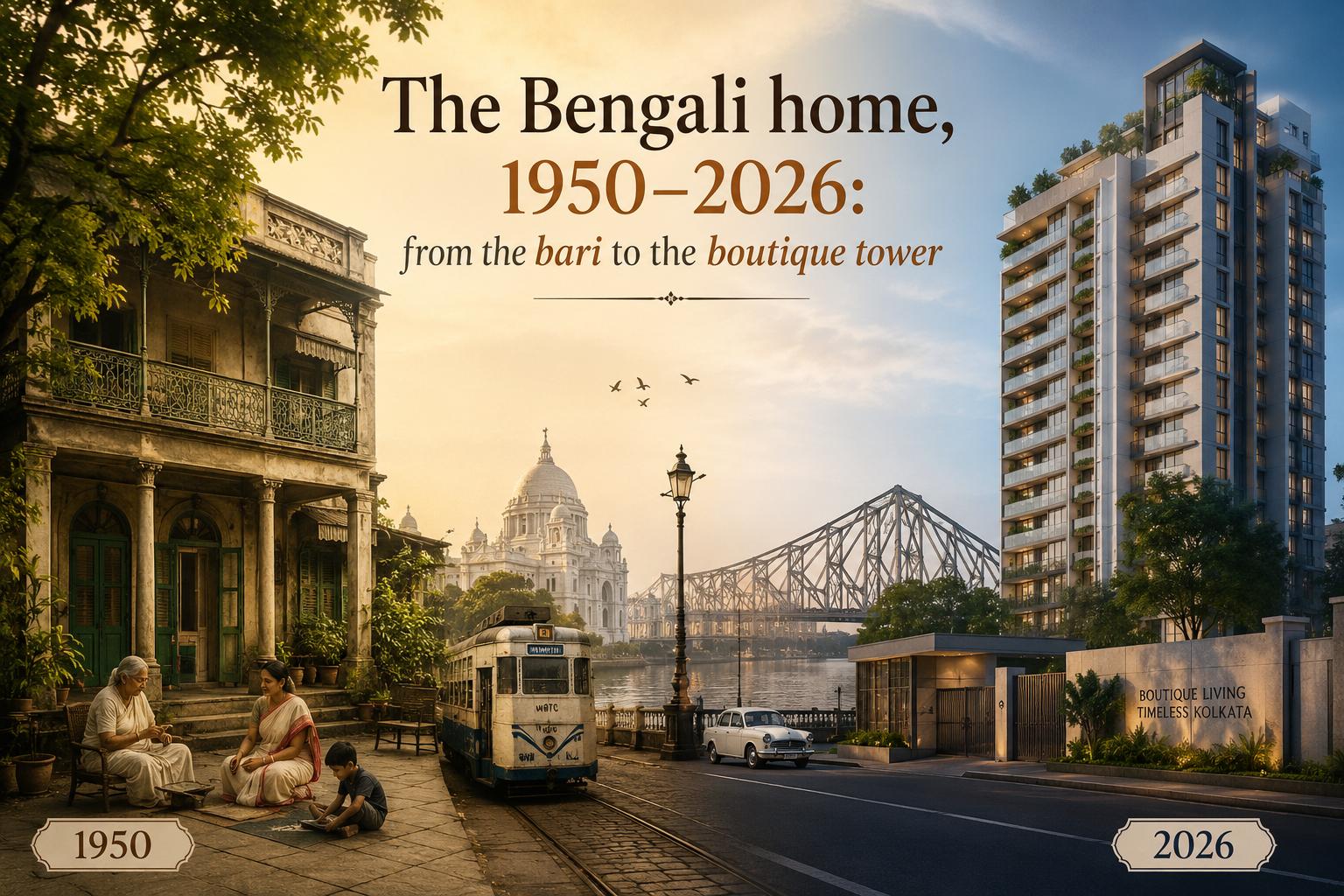
The Bengali Home, 1950–2026: From the Bari to the Boutique Tower
A luxury project in Kasba is currently selling thirty apartments on a promise it prints in capital letters: FEWER NEIGHBOURS.
Read that again, and then think about your grandmother’s house.
The Bengali bari was built on the opposite proposition. More neighbours. More relatives. More noise. Three brothers, their wives, their children, a widowed aunt, and a stream of people who were somehow related in a way nobody could fully explain but everybody accepted. The house was designed to absorb them.
In seventy-five years we have travelled from a home whose central virtue was that it held everyone, to a home whose central virtue is that it holds almost no one. This is the story of how, and — more uncomfortably — of what we bought back at the end of it.
I. THE HOUSE BUILT AROUND A HOLE
The North Kolkata bari has a hole in the middle of it. This is not a defect. It is the entire design.
The uthon — the courtyard — is the room that is not a room. It is where the sun comes in, where the rice dries, where the children are shouted at, where the aunts sit through the afternoon doing nothing in particular and everything at once. Every other room in the house faces it. The house has no view outward and does not want one. It looks inward, at itself.
Around it, the grammar repeats across thousands of houses: the thakur dalan, the pillared hall where Durga arrives every autumn and the family becomes, briefly, a congregation. The baithakkhana, the outer room where men received guests and conducted the long, unhurried, faintly pompous business of Bengali conversation. The andarmahal, the inner quarters, where the women lived — a word we should say plainly rather than romantically, because it was also a boundary, and it was not a kind one. The chhad, the flat roof, where the laundry hung and the kites flew and, in a thousand Bengali novels, where two people who should not have been alone together were alone together.
And at the front, jutting into the street: the rowak. A raised plinth, knee-high, entirely useless in any functional sense. Its only purpose was to be sat on. Boys sat on it for hours. Old men sat on it for decades. The rowak was where the house leaked into the para — the neighbourhood — and where the para leaked back in. It was semi-private, semi-public, and utterly essential, and it is the single most important thing Kolkata has lost.
You cannot buy a rowak. This is a point we will return to.
II. 1947, AND THE CITY THAT MOVED SOUTH
Then the border was drawn, and everything changed.
The refugees who came from East Bengal after Partition — and they kept coming, in waves, for decades — did not arrive to a city with housing waiting. They took land. Fallow land, marshland, the southern fringes that respectable Kolkata regarded as nowhere: Jadavpur, Bagha Jatin, Santoshpur, Bijoygarh, the long southern arc that is now some of the most desirable address in the city. The udbastu colony — the refugee colony — was established by occupation and legalised, grudgingly and slowly, afterwards.
The house that emerged from this was the opposite of the bari in every way that mattered. It was small. It was built by the family that lived in it, often literally, with their own hands. It was single-storey, because that was what could be afforded — but with pillars left standing and rods left exposed, because a second storey would come when a son got a job, and a third when he married.
The Bengali house stopped being an inheritance and became a project.
This is the most under-appreciated fact in Kolkata’s property history: South Kolkata, the part everyone now aspires to, was built by people who had lost everything. The elegance came later. The land was taken by the desperate.
III. THE PROMOTER ARRIVES
By the 1970s the city was in trouble. Industry was leaving. Capital was leaving. Land legislation made assembling large parcels genuinely difficult, and no serious developer could operate at scale. Kolkata, in the decades when Bombay and Delhi were building upward, largely stopped.
Into that vacuum walked a figure who entered the Bengali language as a common noun and stayed there as a mild insult: the promoter.
The promoter’s model was elegant and it reshaped the city. He did not need capital to buy land — he needed a family with an old house and a problem. And there were tens of thousands of them: three brothers who had inherited one bari, could not agree on anything, could not afford the repairs, and could not divide a courtyard four ways.
The promoter’s offer: give me the land. I will demolish the house and build a G+4. You get two flats and some cash. I keep the rest.
It was, on the numbers, often a fair deal. It was also, culturally, an extinction event. Across North and South Kolkata, one bari at a time, the courtyard was filled in, the thakur dalan came down, and the rowak was scraped off the street to make room for a car. The family that had lived in one house together now lived in two flats separately, in a building where they did not know the people on the third floor.
Nobody planned this. It happened one deed at a time, and it happened to almost everyone.
IV. SALT LAKE, AND THE INVENTION OF THE PLAN
And then, across the city, something entirely different was rising out of a salt marsh.
Bidhannagar — Salt Lake — was reclaimed and laid out in the 1960s as something Kolkata had never had: a planned residential city. Numbered sectors. Blocks with letters. Plots allotted rather than inherited. Wide roads that went where they said they would go.
For a generation of Bengali professionals, the Salt Lake plot became the new arrival signal — the thing you got when you had made it. And the house built on it was a genuinely new object: outward-facing, set back from the road, with a garden in front rather than a courtyard within, and a boundary wall that said, politely but unmistakably, that the para stopped here.
The bari had faced inward and been open to the street. The Salt Lake house faced outward and was closed to it. That inversion is worth sitting with.
V. THE COMPLEX
Liberalisation, the IT corridor at Sector V, Rajarhat, New Town, NKDA. From the 1990s onward, Kolkata began — belatedly, and then rapidly — to build the thing every other Indian metro had already built: the gated complex.
Towers. A boundary wall. A guard. A clubhouse, a gym, a pool, landscaped gardens, a community hall. Two hundred families, five hundred families, seven hundred families, living in a place with a name that ends in Heights or Greens or Vista.
The complex solved real problems, and we should be honest about that. It gave people lifts, parking, water pressure, security, and a functioning drainage system — none of which the bari reliably offered. It gave women a front door that locked and a life that was not adjudicated by a mother-in- law across a courtyard. Anyone who mourns the bari without acknowledging what the flat liberated people from is selling nostalgia, not history.
But something did go. The para — the neighbourhood as a social unit, with its own club, its own Puja, its own hierarchy of uncles and its own unbearable gossip — does not survive a boundary wall. The complex has residents. The para had characters. You cannot hold an adda in a lobby.
VI. 2026: THE BOUTIQUE TOWER
Which brings us to the present, and to the strangest turn in the whole story.
The newest, most expensive thing you can buy in Kolkata today is not the biggest complex. It is the smallest one. Thirty homes. One tower. A private clubhouse for a community deliberately kept tiny. The lobby is never crowded. The pool never feels public. Seventy percent of the land is left open.
And here is what nobody says out loud: read that list of features again, and it is a bari. Priced at five crore.
The uthon has come back as the landscaped zen garden — open space at the heart of the plot, which the whole building faces. The chhad has come back as the rooftop terrace. The baithakkhana has come back as the lounge. The thakur dalan, where the family gathered for Puja, has come back as the banquet hall with attached kitchen. The triple-height terrace is the double height of the old pillared hall, rediscovered by an architect who may never have set foot in one.
We spent seventy-five years methodically demolishing the courtyard house. And now the market’s most premium product is a courtyard house, sold back to us — smaller, cleaner, plumbed properly, and with the relatives removed.
That last clause is the whole business model. The bari gave you the courtyard and the crowd together, because they were the same thing. The boutique tower has worked out how to sell the courtyard without the crowd. It has commodified the amenity and deleted the obligation. FEWER NEIGHBOURS is not a slogan. It is the invoice.
VII. WHAT IT COST, HONESTLY
It would be easy to end here with a lament, and it would be dishonest.
The bari was beautiful and it was also a nightmare. It was patriarchal, it was litigious, it flooded, it leaked, its plumbing was theoretical, and its inheritance disputes destroyed families for three generations. The women confined to the andarmahal did not experience it as architecture; they experienced it as a wall. Most Bengalis who left it left gratefully, and they were right to.
The flat was not a fall. For millions of people, it was an escape.
But something was traded, and it is worth naming precisely. What we lost was not the courtyard — the developers have proven they can rebuild the courtyard. What we lost was the rowak: the semi-public edge, the part of the home that belonged partly to the street. Every architectural form since 1950 has moved in one direction, which is inward and away. The refugee house had a boundary. The Salt Lake house had a wall. The complex had a gate. The boutique tower has a gate, a guard, a lobby, a lift with a key fob, and twenty-nine other families, carefully selected.
We have not stopped building the Bengali home. We have simply stopped building the part of it that faced outward — and we now pay a premium, explicitly, for the guarantee that fewer people will be on the other side of the door.
Whether that is progress or loss is not a question a property company should be answering for you. But it is, we think, a question worth asking before you sign.
Sidus Realty has spent fifteen years selling Kolkata homes, which means we have also watched a lot of them come down. If you are trying to work out what you actually want from a home — not just what it costs — that is a conversation we are happy to have, at no charge and with no obligation.