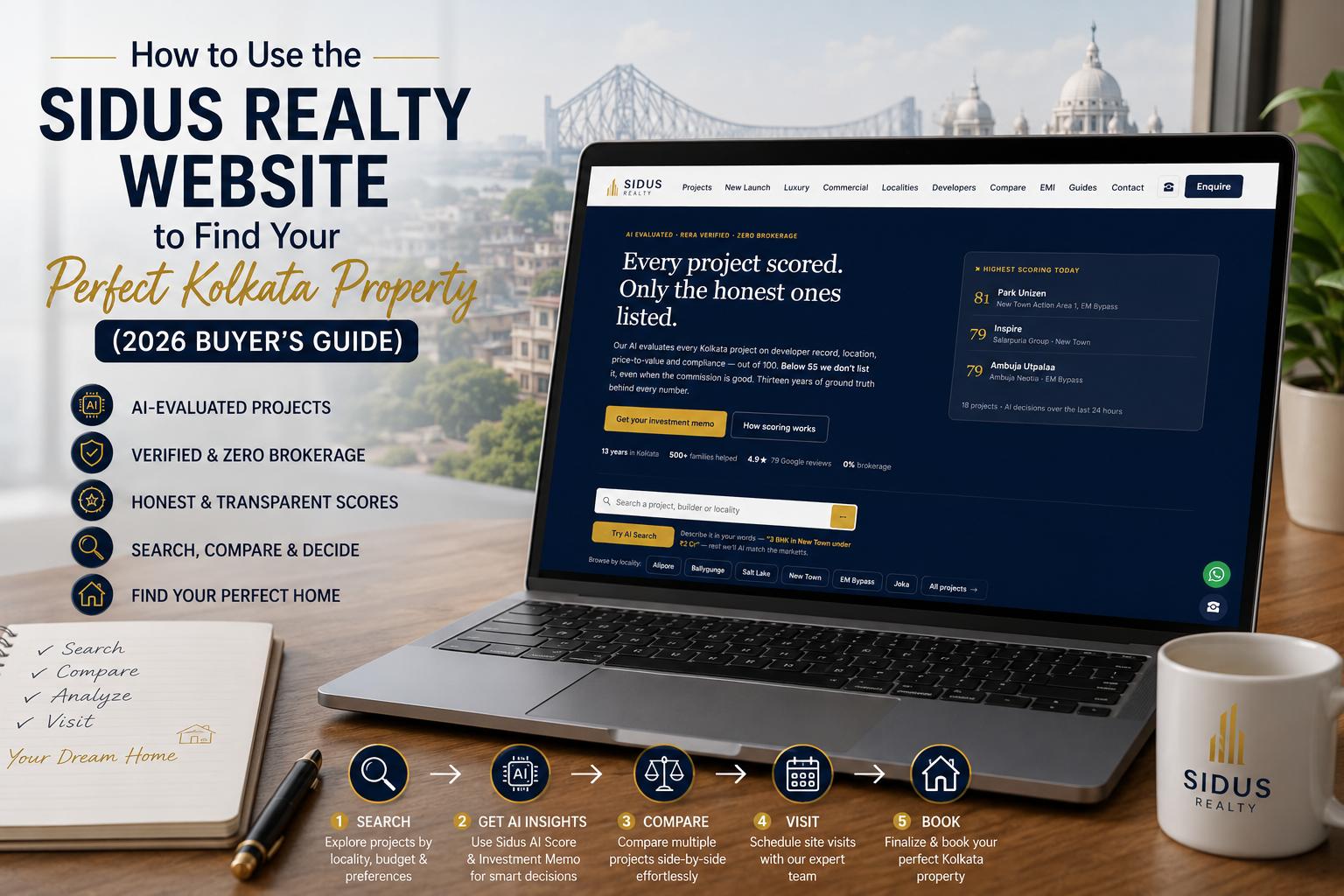
Kolkata has over 300 active residential projects at any given time. Most look identical on a brochure — glossy renders, “world-class amenities,” a price per square foot that somehow never quite adds up when you ask about GST, parking, and club charges separately.
Sidus Realty was built to cut through that. We’re a Kolkata-based luxury real estate channel partner with 13 years of on-ground experience, working directly with developers like Salarpuria/Sattva, DTC, Belani, Srijan, Merlin, Ambuja Neotia, PS Group, Primarc, Signum, Peerless, Vinayak, and Emami — and we don’t charge buyers any brokerage. We’re paid by the developer, not by you.
But the real difference isn’t who we work with. It’s what we built: a website that does the analytical heavy lifting most buyers do manually, badly, and too late — usually after they’ve already paid token money.
This guide walks you through every tool on sidusrealty.com, in the order you should actually use them, so you get the maximum value out of each one before you ever pick up the phone.
Step 1: Understand the Sidus Score Before You Look at a Single Project
Start at Sidus Score Methodology.
Before you fall in love with a render, it helps to know what you’re actually being shown. Every project on our shortlist is evaluated on four dimensions and given a single score out of 100:
- Developer Track Record — years operating in Kolkata, on-time delivery history, construction quality reputation, financial stability, and how well they run maintenance after handover.
- Location Fundamentals — the single biggest factor in a 10-year outcome. Connectivity, employment proximity (Sector V, New Town IT corridor), social infrastructure, historical price trajectory, and whether the micro-market is getting overbuilt.
- Price-to-Value — whether the ₹/sqft actually matches what you’re getting, including loading factor (carpet vs super built-up) and whether “offers” are genuine or marketing inflation on an inflated base.
- Construction & Compliance — RERA status, approvals, current construction stage vs. the promised schedule, financial closure, and handover cushion.
Score bands are simple: 85+ is Standout, 70–84 is Solid, 55–69 is Consider Carefully, and below 55, we don’t list the project at all — even if the commission is attractive. That last part matters more than it sounds: most portals list everything a developer is willing to pay to advertise. We don’t.
The exact weightings stay private — they’re the result of 15 years of Kolkata transaction data and are, frankly, our IP. But the framework itself is fully public, so you know exactly what’s being measured before you trust a number.
Why this step matters: once you understand the four dimensions, every project page on the site becomes readable in a completely different way. You stop reacting to a headline number and start asking which of the four pillars is actually doing the work.
Step 2: Skip the Filters — Just Describe What You Want
Most Kolkata property portals hand you a wall of dropdown filters: locality, BHK, price band, possession status, amenities — and you end up clicking through six of them just to see if anything actually matches what you had in mind.
Sidus Realty’s AI Search lets you skip that entirely. Instead of filtering, just describe your requirement in plain language — the way you’d explain it to a person:
“3 BHK near New Town under 2 Cr with metro connectivity and possession within a year”
“Investment-friendly project on EM Bypass with strong rental demand”
“Family home in a quiet locality, good schools nearby, ready to move”
The AI reads the intent behind the sentence — locality, budget, configuration, timeline, and priorities like connectivity or rental yield — and returns matching projects from our shortlist, ranked with the same evaluation logic behind the Sidus Score. You can refine in a follow-up sentence rather than resetting a filter panel.
Why this matters: filters force you to already know the exact parameters of what you want. Most buyers don’t — they know it in terms of a lifestyle or a goal (“close to my office,” “something that’ll appreciate well,” “won’t outgrow it in five years”). AI Search lets you start from that instead, and narrows the technical filtering down for you.
Step 3: Browse Projects and Use the Comparison Engine
Head to /compare/ once you have two or three projects in mind.
Kolkata buyers almost always shortlist across localities before committing — an EM Bypass project against a New Town one, or a Tollygunge redevelopment against something in Rajarhat. Doing that comparison from memory, across five open browser tabs and three different brochures, is how people miss the detail that actually matters (loading factor, RERA timeline, or a possession date that’s later than it looks).
Our Comparison Engine puts projects side by side on identical fields — price, configuration, size, developer, locality, Sidus Score — in a card layout that also works cleanly on mobile, since most of our traffic is people comparing projects on their phone during a commute or a lunch break.
Practical tip: compare within the same price band first, then across price bands only if you’re genuinely flexible on budget. Comparing a ₹1.8 Cr project against a ₹4 Cr one rarely produces a useful decision — it produces a rationalization.
Step 4: Run the Numbers With the Tools Suite
Go to /tools/ for four calculators built specifically for the current West Bengal regime — no leftover pandemic-era rebates, no discontinued concessions baked into the math:
- Total Cost Calculator — the real all-in number: base price plus stamp duty and registration at current WB rates (7% stamp duty above ₹1 Cr in urban WB, 6% at or below ₹1 Cr, plus 1% registration).
- Carpet vs. Super Built-up Calculator — converts the loading factor developers quote into the actual usable space you’re paying for. This single number kills more deals than any other, once buyers actually see it.
- Rent vs. Buy Calculator — a genuinely useful tool if you’re weighing a self-use purchase against continuing to rent in the same corridor while prices settle.
- EMI Calculator — standard loan math (typically modeled on 80% financing, 20-year tenure) so you know your monthly outflow before you’re sitting across from a loan officer.
Important note we build into every calculator: the women’s stamp duty concession was discontinued in July 2024, and there is no 2%-off pandemic-era rebate anymore. If a broker or a WhatsApp forward quotes you either of those, the number is stale — don’t let it anchor your budget.
Step 5: Open a Project Page and Read the Sidus Score Gauge
Every project page carries a live AI Score Display — an animated circular gauge with the total score, and four dimension cards (Developer Trust, Location Intelligence, Price-to-Value, Compliance) with fill bars showing how the project performs on each.
You’ll notice something deliberate here: the public page shows labels (Strong, Solid, Fair, Weak) but not the exact sub-score numbers. That’s not an accident — it’s how we keep the evaluation honest and gate the fully detailed breakdown behind the next step, which is also the step that gets you a real, personalized answer instead of a generic one.
Step 6: Generate Your Free Personalized Investment Memo
This is the tool most Kolkata buyers don’t know exists anywhere else, and it’s the one we’d point you to first if you only had time for one.
Go to /tools/investment-memo/, or click “Generate My Memo” directly from any project page (it pre-fills automatically).
The wizard takes four short steps:
- Which project you’re considering.
- Why you’re buying — to live in, as an investment, or both (live now, sell later).
- Your budget range and purchase timeline.
- Your name and phone number, so we can send the memo and follow up on anything it raises.
In about 30 seconds, our AI — trained on the same evaluation framework behind the public Sidus Score — generates a structured, seven-section memo built specifically for your situation:
- Executive summary naming the project, developer, and verdict at a glance.
- The full private sub-score breakdown — the exact numbers behind the public labels, unlocked because you identified yourself to see them.
- Fit-for-intent analysis — what genuinely works for your stated goal, and what to consider honestly, not marketing-softened.
- Financial Reality Check — the true all-in cost: base price, stamp duty, registration, and whether that fits, is tight, or exceeds your stated budget.
- Market context — corridor CAGR, comparable supply nearby, confirmed infrastructure impact, the nearest employment driver, and how active resale actually is in that locality.
- Financial scenarios matched to your intent — end-users get EMI, break-even-vs-rent, and equity build-up; investors get rental yield, cash-on-cash return, and a blended IRR estimate. All financial projections are clearly labeled as estimates based on Kolkata benchmarks, not guarantees.
- An honest risk matrix with specific mitigations — not boilerplate disclaimers.
- A direct recommendation: proceed, book a site visit first, conditional pass, or look elsewhere — plus three concrete action items and 2–3 comparable projects at your price point.
You can print it or save it as a PDF directly from the page, and a WhatsApp button lets you continue the conversation with our team the moment you’re ready.
Why this is worth the phone number: anyone can scrape a public score off a listing site. The reasoning behind that score — the specific sub-scores, the rationale, the risk detail — is where the actual decision-making value lives, and we only hand that over to people who are seriously evaluating a purchase, not to competitors building a copycat database.
Step 7: Check Real Reviews, Not Cherry-Picked Testimonials
Visit /reviews/ to see our aggregate Google rating (4.9★ from 79 reviews) reflected with proper review schema, plus a curated set of the most detailed, verified reviews from actual buyers we’ve worked with over 13 years.
We’d rather show fewer, real reviews than a wall of generic five-star quotes with no context. If a review doesn’t tell you something specific about the buying experience, it doesn’t earn a spot on the page.
Step 8: Talk to a Human
Once you’ve run the numbers and read your memo, reach our team directly on WhatsApp: +91 82402 22529. No spam, no auto-dialer sequence — just a follow-up on the specific questions your memo raised, and a site visit scheduled around your timeline, not ours.
Frequently Asked Questions
Is the Investment Memo Generator actually free? Yes. You pay nothing — we’re compensated by the developer when a sale closes, not by buyers, and not for generating a memo.
Does a high Sidus Score guarantee the project will perform well? No. It’s a rigorous evaluation as of today, based on the best available data — not a guarantee. Markets shift and developers change. A high score means we’ve validated the project seriously; it doesn’t replace a site visit, a read of the sale deed, and your own due diligence.
Why don’t you publish the exact scoring weights? The weightings are the product of 15 years of Kolkata-specific transaction data, refined every quarter. Publishing the exact formula would let it be reverse-engineered without anyone having done the underlying work — and it wouldn’t actually help you make a better decision; the four-dimension framework already tells you what’s being measured.
Can the score be influenced by commission? No. We’ve declined to list projects that failed our evaluation despite attractive commercial terms, and projects scoring below 55 aren’t listed regardless of what they’d pay us.
What areas does the Location Intelligence dimension actually weigh? Connectivity (metro access, arterial roads, upcoming confirmed infrastructure), proximity to employment hubs like Sector V and the New Town IT corridor, social infrastructure, the micro-market’s historical price trajectory, and whether the area is being overbuilt.
The Bottom Line
Most Kolkata real estate sites are built to get you to fill out a lead form as fast as possible. Ours is built to get you to a genuinely informed decision first — and the lead form only shows up when you’re ready to see the private numbers behind the public score.
Start at the Sidus Score page, describe what you’re looking for with AI Search instead of clicking through filters, run your numbers through the Tools Suite, and when you’ve narrowed it down, generate your free Investment Memo. It’s the fastest honest path from “I’m looking” to “I know exactly what I’m buying and why.”