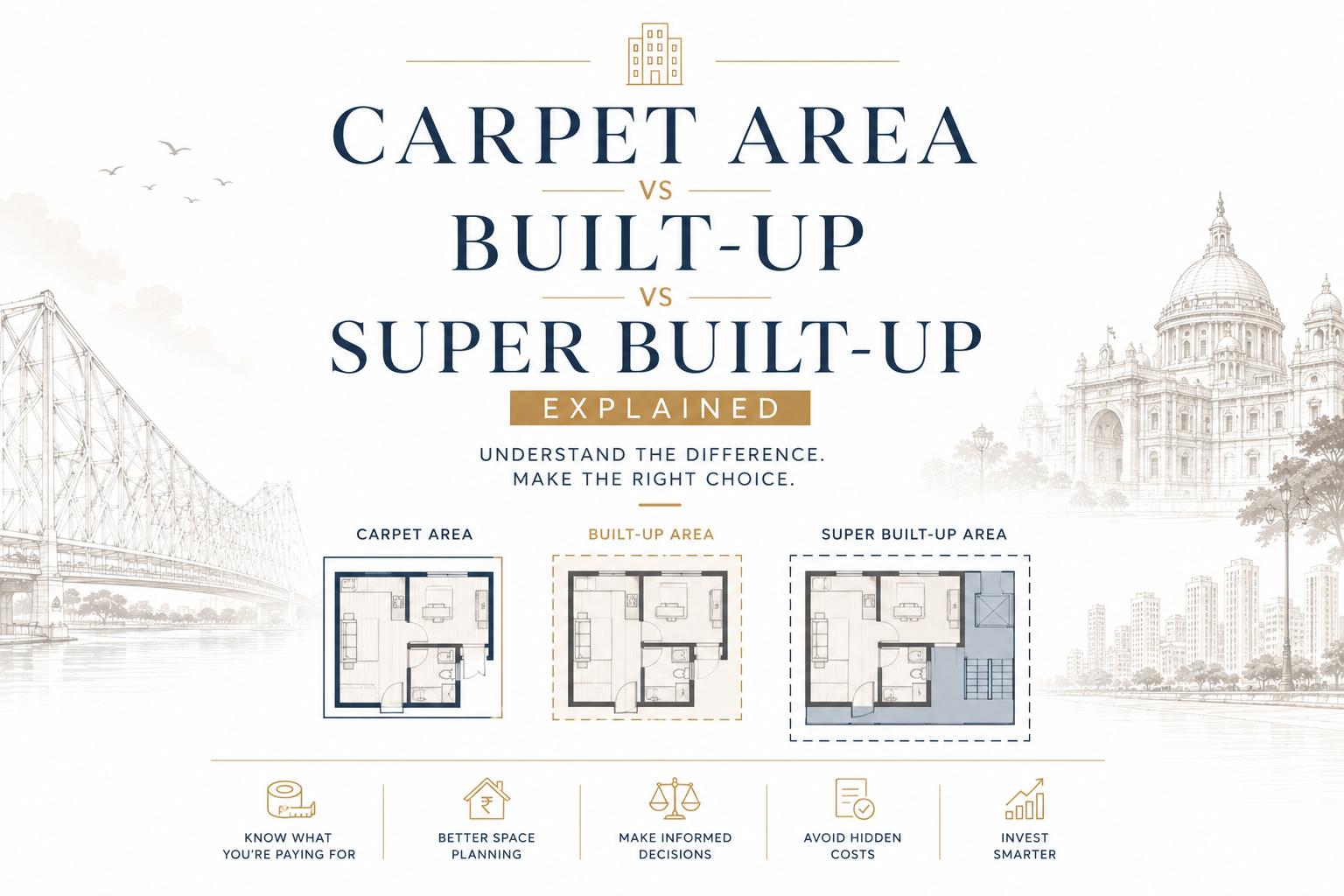

When a developer says a flat is “1,500 sq. ft.”, which 1,500 sq. ft. do they mean? The answer changes your effective cost per sq. ft. by 20–40% — and most buyers only find out after booking. Here is exactly what each measurement means, why it matters, and how to use it when comparing projects in Kolkata.
The three measurements — and what they include
Carpet area
Carpet area is the actual usable floor space inside your apartment — the area where you can lay a carpet. It includes all rooms (bedrooms, living room, kitchen, study), internal walls, and the area inside your flat’s entrance door. It does not include external walls, balconies, terraces, or any common areas.
This is the number RERA mandates developers to disclose. Under the West Bengal Real Estate (Regulation and Development) Rules, all project registrations and sale agreements must state carpet area clearly — making it the most legally reliable measurement to use when comparing flats.
Built-up area
Built-up area is carpet area plus the thickness of the external walls of your apartment and the area of your balconies or terraces. Depending on wall thickness and balcony size, built-up area is typically 10–15% more than carpet area.
You are paying for wall space you cannot use, and for balcony area at the same rate as your living room. Some developers quote this number because it sounds more impressive than carpet area — while still being lower than super built-up.
Super built-up area
Super built-up area — also called saleable area — is built-up area plus your proportionate share of all common spaces in the building. This includes the lift lobby, staircase, corridors, security cabin, pump room, generator room, and sometimes even the clubhouse in older projects.
Super built-up area is typically 25–40% more than carpet area, depending on how the developer calculates the loading factor. A flat with 1,000 sq. ft. of carpet area could be sold as 1,300–1,400 sq. ft. super built-up — and the developer’s price per sq. ft. is applied to that higher number.
This is the number most Kolkata developers historically quoted — and the one that inflates the apparent size of a flat most dramatically.
How they relate to each other
| Measurement | What it includes | Typical size relative to carpet area |
|---|---|---|
| Carpet Area | Usable floor space inside the flat + internal walls | Base (100%) |
| Built-Up Area | Carpet area + external walls + balconies | ~110–115% of carpet area |
| Super Built-Up Area | Built-up area + proportionate share of common areas | ~125–140% of carpet area |
In plain terms: if a developer tells you a flat is 1,400 sq. ft. super built-up, the space you actually live in — the carpet area — is likely around 1,000–1,050 sq. ft.
What is a loading factor?
The loading factor (also called the load factor or common area factor) is the percentage added to built-up area to arrive at super built-up area. It represents your share of the building’s common spaces.
A loading factor of 25% means that for every 100 sq. ft. of carpet area, you are paying for 125 sq. ft. of super built-up. A loading factor of 40% means you are paying for 140 sq. ft. A lower loading factor is better for the buyer — it means more of what you are paying for is actual usable space.
Loading factors in Kolkata typically range from 20% to 40%. Older, smaller buildings with simpler designs tend to have lower loading. Large premium towers with elaborate lobbies, multiple lift banks, wide corridors and large common areas have higher loading factors. Always ask the developer to state the loading factor explicitly — and compare it across projects you are evaluating.
A worked example with real numbers
Two developers quote you a flat at ₹8,000 per sq. ft. Project A quotes on carpet area; Project B quotes on super built-up area with a 30% loading factor.
| Project A (carpet area) | Project B (super built-up) | |
|---|---|---|
| Quoted area | 1,000 sq. ft. | 1,000 sq. ft. |
| Actual carpet area | 1,000 sq. ft. | ~769 sq. ft. |
| Price per sq. ft. | ₹8,000 | ₹8,000 |
| Total price | ₹80,00,000 | ₹80,00,000 |
| Effective cost per sq. ft. of usable space | ₹8,000 | ₹10,400 |
Same quoted price. Same quoted area. But Project B’s flat has 231 sq. ft. less usable space — and costs 30% more per sq. ft. of space you can actually live in. This is how an apples-to-apples price comparison becomes misleading if you do not check which measurement is being used.
What RERA changed — and what it means for Kolkata buyers
Before RERA, most Indian developers quoted and sold on super built-up area with no obligation to disclose carpet area. Buyers had little way of knowing how much of what they paid for was actually usable space.
RERA changed this. Under the Real Estate (Regulation and Development) Act, 2016, developers are legally required to sell on carpet area and to state it clearly in all agreements, brochures and disclosures. West Bengal’s WBRERA enforces this for all registered projects.
In practice, most Kolkata developers still mention super built-up area in marketing materials because it is the larger number — it makes a flat sound bigger. But the sale agreement and RERA registration must reflect carpet area. When you compare projects, always ask: “What is the carpet area of this unit?” — and use that number to calculate your true cost per sq. ft.
How to compare projects correctly
When you receive a price from a developer or channel partner, follow these three steps before drawing any conclusions:
- Confirm which measurement the price is based on — carpet area, built-up, or super built-up. Do not assume.
- Get the carpet area in sq. ft. for the exact unit you are considering. This is on the WBRERA registration for every registered project.
- Calculate your effective cost per sq. ft. of carpet area — divide the all-in price (base price + PLC + parking) by the carpet area. Use this number to compare across all projects you are evaluating.
This single adjustment will often change the ranking of projects you are comparing. A project that looks cheaper per sq. ft. in marketing may turn out more expensive once you calculate on carpet area — and vice versa.
Frequently asked questions
Which measurement should I use when applying for a home loan? Banks sanction loans based on the agreement value, not the area measurement. However, the bank’s technical team will value the property based on carpet area and circle rates — so carpet area indirectly affects how much the bank is willing to lend.
Does balcony area count in carpet area? No. Under RERA, balconies and open terraces are excluded from carpet area. They are included in built-up area. Some developers charge separately for balcony area — always check the cost sheet.
Is a lower loading factor always better? Generally yes for the buyer — it means more of what you pay for is usable space. However, a slightly higher loading factor in a building with wide corridors, a grand lobby and multiple lifts may indicate better common infrastructure, which supports resale value. Do not dismiss a project solely on loading factor — look at what the common areas actually deliver.
Why do developers still advertise in super built-up area if RERA mandates carpet area? RERA mandates carpet area in legal documents and official disclosures — not in all marketing. Advertising on super built-up area is still common because it shows a larger number. This is why you must always confirm carpet area before making any comparison or decision.
How do I find the carpet area of a RERA-registered project? Visit rera.wb.gov.in, search by project name or RERA number, and check the project registration details. The carpet area of each unit type is disclosed there.
Still confused about the numbers on a project you are looking at? Talk to our team — we will break down the carpet area, loading factor and effective cost per sq. ft. for any project across our full listings, with zero brokerage.
Disclaimer: Area calculations and loading factors vary by project and developer. Always refer to the RERA-registered carpet area in the sale agreement as the legally binding measurement for your purchase.